OASIS-Map: Object-Level Change Detection in Multi-Session Mapping using Semantic Correspondence Matching
Haedam Oh, Yifu Tao, Nived Chebrolu, Maurice Fallon
 Arxiv
Arxiv Paper
Paper  Video
Video Code
Code
Overview
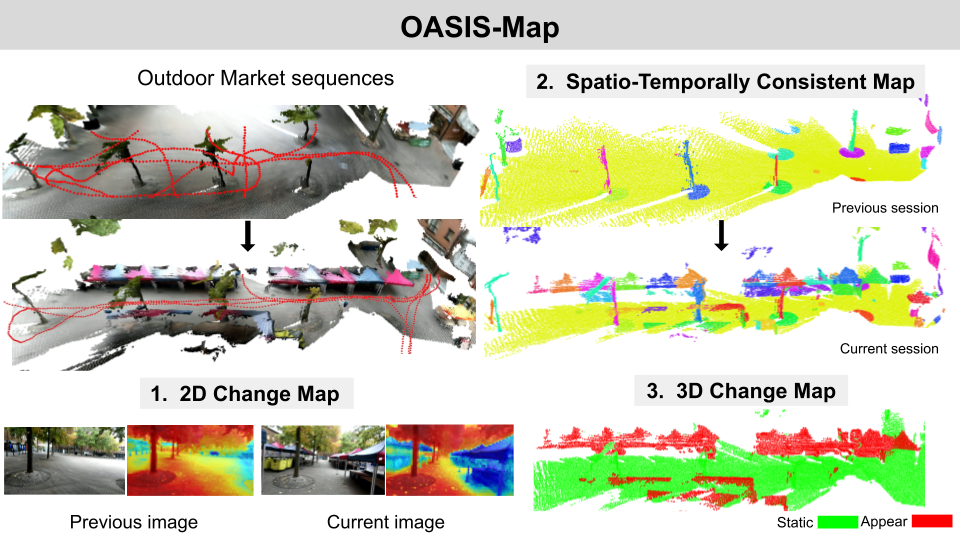
Environments change between robot visits — objects get moved, replaced, or removed — which quickly makes a single-session map outdated. OASIS-Map keeps a map spatio-temporally consistent across revisits by establishing dense semantic correspondences between what the robot sees now and what it saw in earlier sessions, even under partial views, occlusion, and imperfect segmentation.
For each revisit, the system outputs:
- 2D change map — dense semantic correspondences between the previous and current session images provide the change signal, as match confidence scores and matches
- Spatio-temporally consistent object map — object identities preserved across sessions, even as objects move or are replaced
- 3D change map — static, appeared, and disappeared regions localised in the 3D reconstruction
Experiments
- Frontend
- Geometric & Object Mapping
- Backend
- Dense Semantic Correspondences
- Object Association
- Change Detection
- Spatio-Temporally Consistent Mapping
1
Outdoor RGB-LiDAR (Car Park)
Highlight: Dense Semantic Correspondence Matching
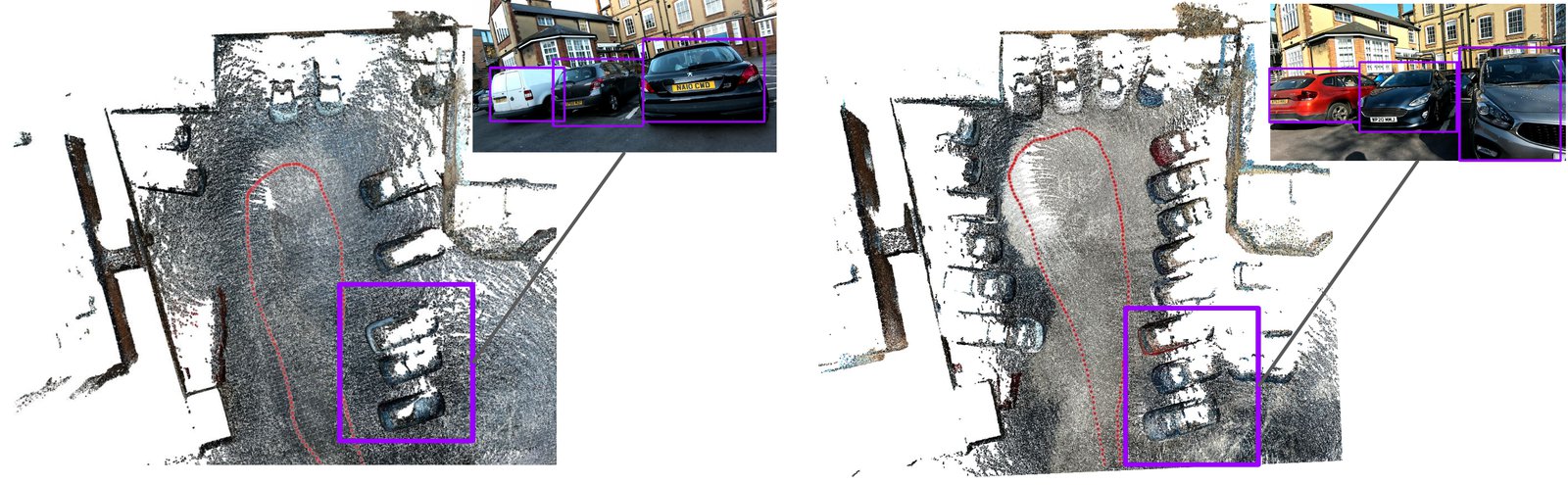
Previous session
Current session
Frontend: Geometric & Object Mapping
- Builds a geometric map and an object map for a first session using RGB-LiDAR.
- Uses 2D-3D object tracking to incrementally build the object map.
Backend: Dense Semantic Correspondences
- Dense semantic correspondences are computed between the previous and current session images.
- Low confidence scores mean changed regions (e.g. cars), while high confidence means persistent objects (e.g. buildings).
Backend: Results
2
Indoor RGB-D Sequence (3RScan)
Highlights: Object Association, Change Detection, Spatio-Temporal Consistency
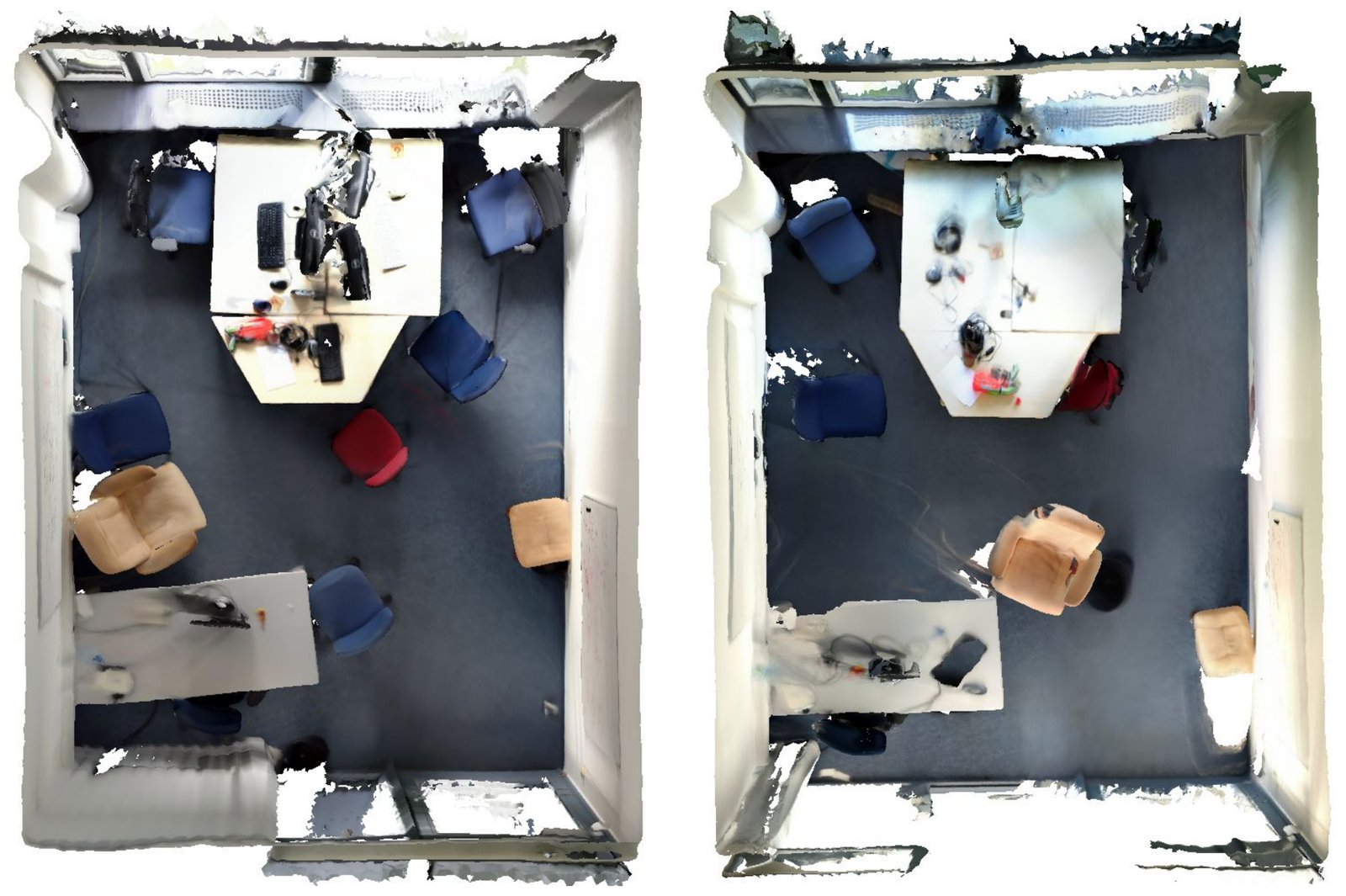
Previous session
Current session
Frontend: Geometric & Object Mapping
- Using RGB-D, an object map is incrementally built.
Backend: Object Association
- Every object in the current session is incrementally associated against the previous session's map by match confidence.
- Detects within-view change (object moves locally) and out-of-view change (object moves across the scene).
Backend: Change Detection
- Change detection is done for objects: Appear / Disappear / Static / Moved.
- If an object is not seen in one of the sessions, it remains Unknown.
Backend: Spatio-Temporally Consistent Mapping
- The map maintains spatio-temporal consistency by preserving object identities.
- Object segmentation remains consistent over time.
Citation
@article{oh2026oasismap,
  title={{OASIS-Map}: Object-Level Change Detection in Multi-Session Mapping
using Semantic Correspondence Matching},
  author={Oh, Haedam and Tao, Yifu and Chebrolu, Nived and Fallon, Maurice},
  year={2026},
  note={Under review}
}