SG-ODOM: Event-Driven Proprioceptive State Estimation with Stability-Gated Contact Updates for Legged Robots
Francesco Iotti*, Chiyun Noh*, Franco Angelini, Manolo Garabini, Ayoung Kim, Maurice Fallon, Frank Dellaert
* Equal contribution



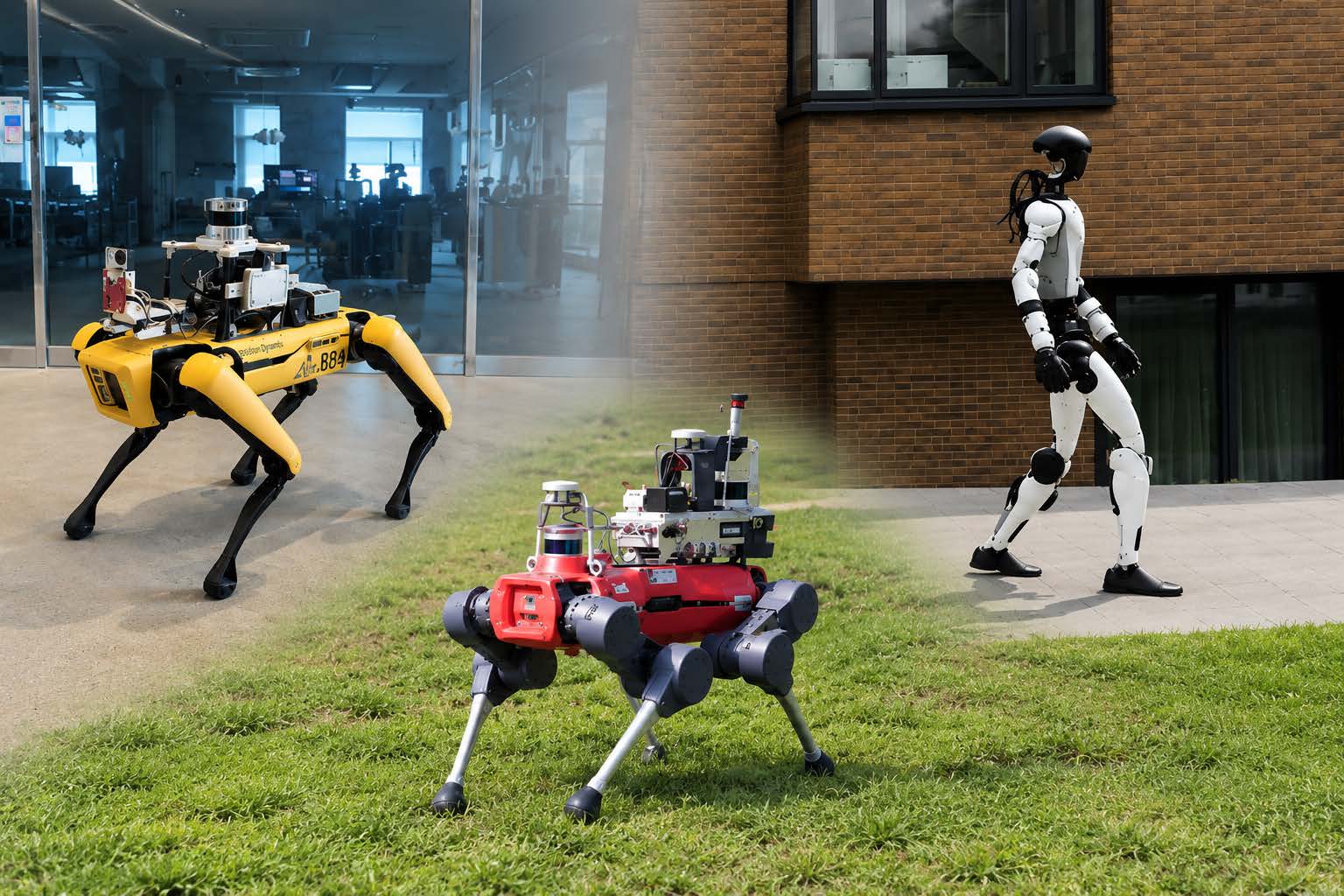
SG-ODOM is a proprioceptive odometry framework for legged robots that fuses IMU propagation with leg kinematics, using stability-gated contact selection to decide when kinematic corrections are applied. Physical touchdown does not necessarily provide a stationary reference, particularly during impact and load transfer, so a contact is accepted for state estimation only once the foot reaches a sufficiently stable support condition. Each validated touchdown triggers an immediate estimator correction, while timeout updates bound the maximum duration of IMU-only propagation.
The same back end runs on quadrupedal and humanoid robots, and is implemented in GTSAM both as an invariant extended Kalman filter (InEKF) and as a fixed-lag smoother. Only a small robot-specific front-end changes between platforms. SG-ODOM reduces translational Relative Pose Error (RPE) by approximately 25% compared to the onboard ANYbotics estimator across seven outdoor missions of the GrandTour dataset.
Tested Platforms
| Robot | Type | Data |
|---|---|---|
| Boston Dynamics Spot | Quadruped | Four indoor and outdoor sequences from the GaRLILEO dataset |
| ANYbotics ANYmal D | Quadruped | Seven outdoor missions from the GrandTour dataset |
| Unitree G1 | Humanoid | Two self-collected outdoor sequences |
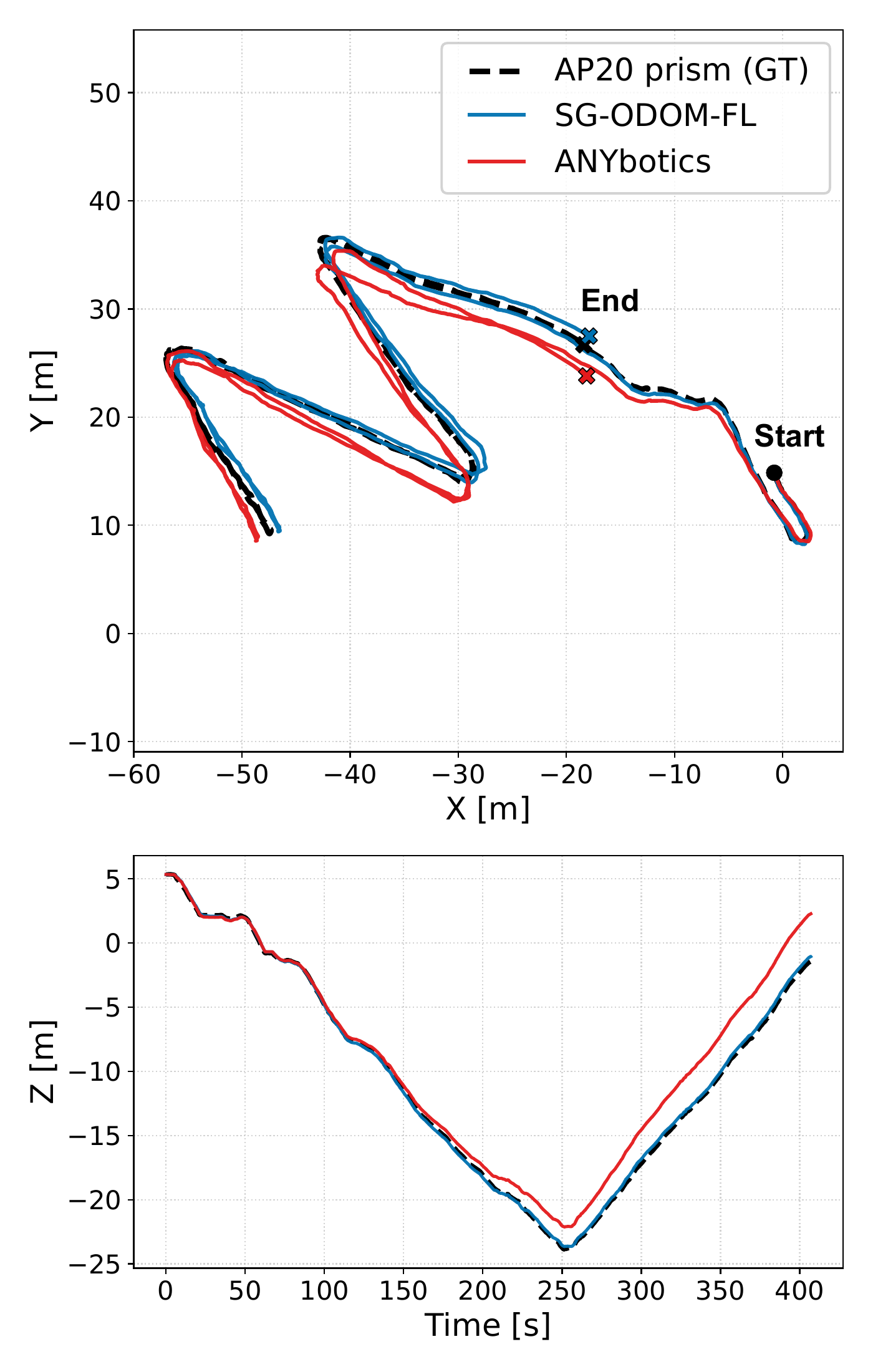
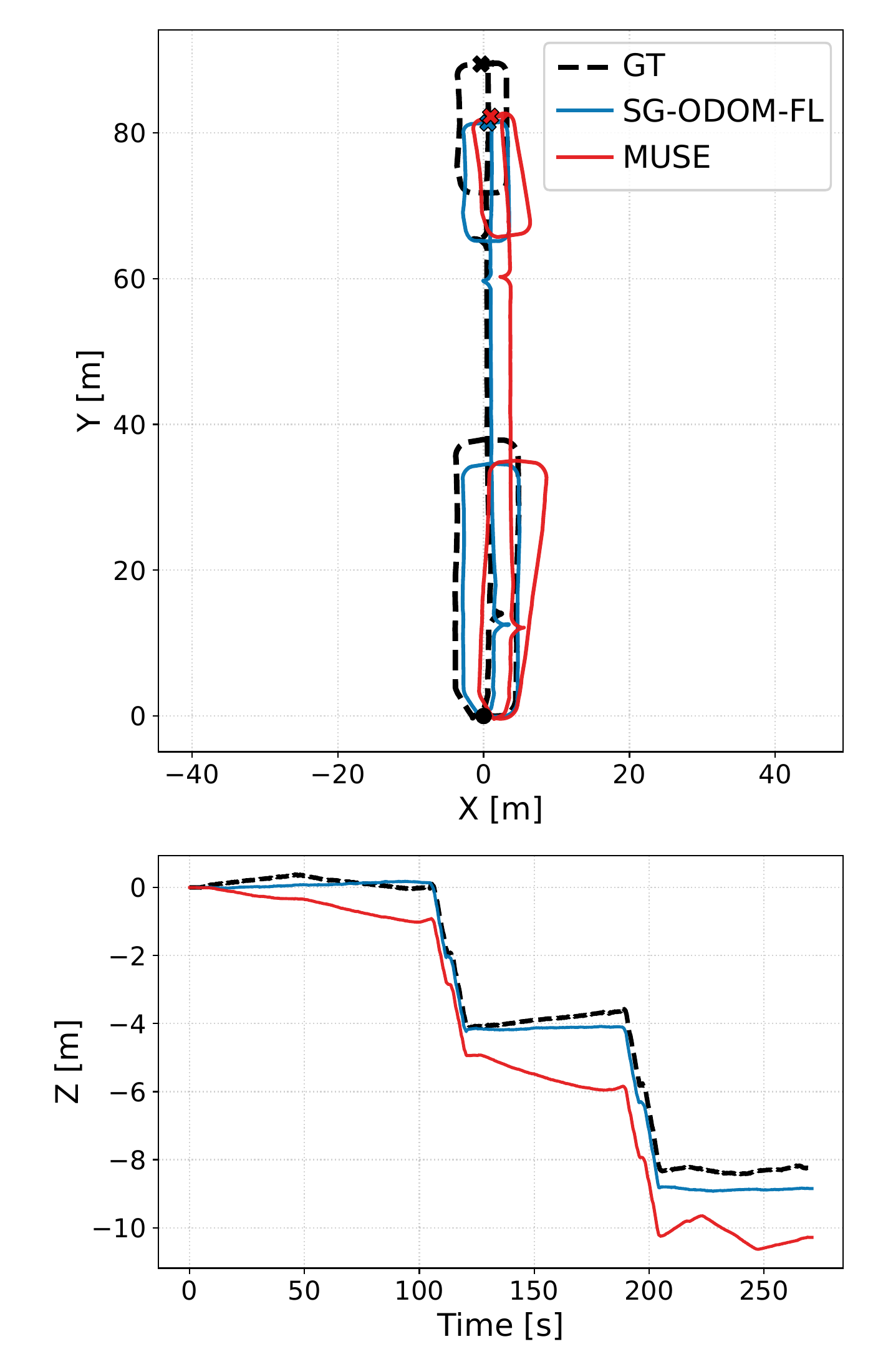
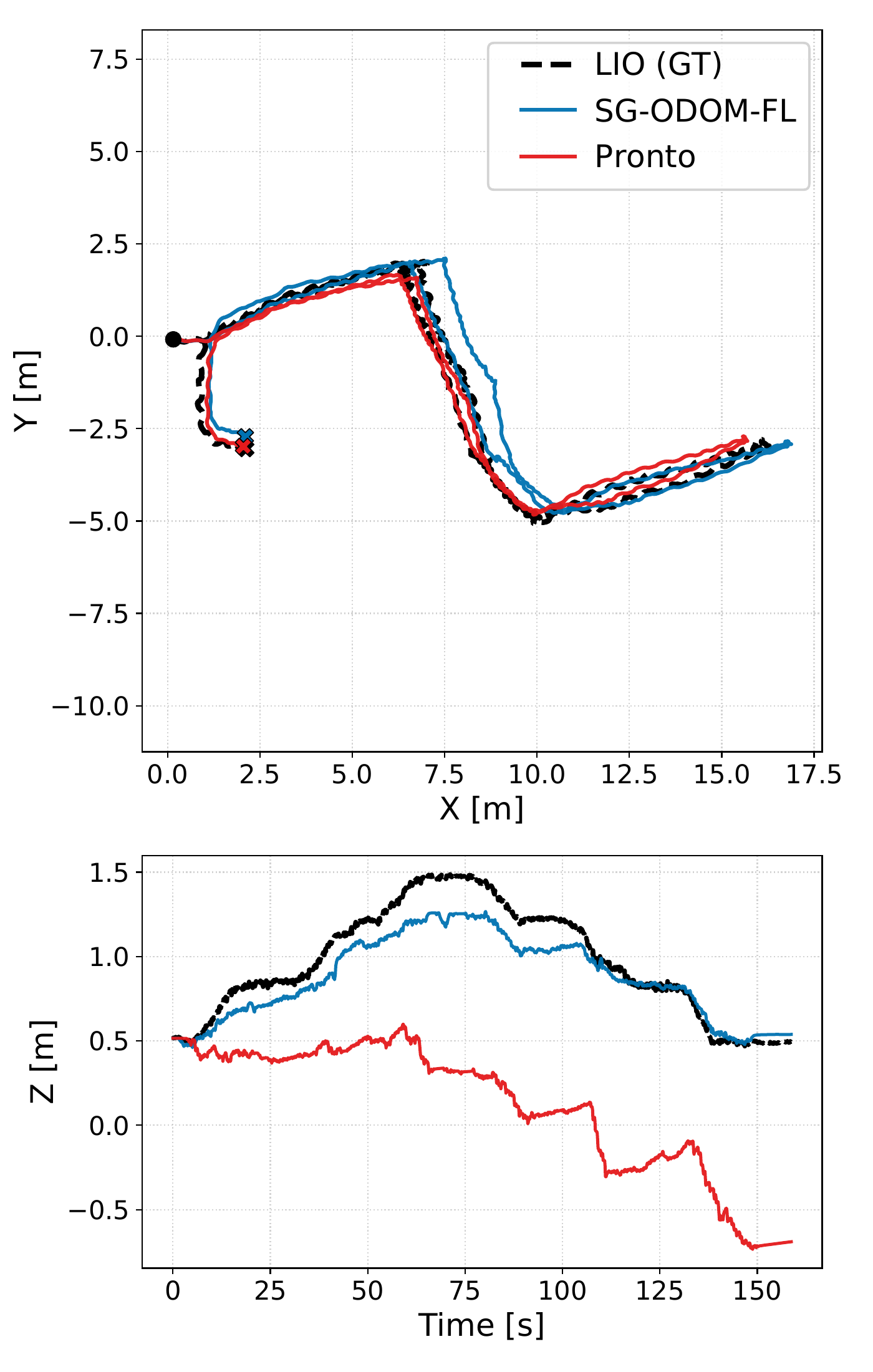
SG-ODOM-FL (blue) tracks the reference trajectory more closely than the baselines (red), with noticeably less vertical drift on stairs and slopes.
Method Overview
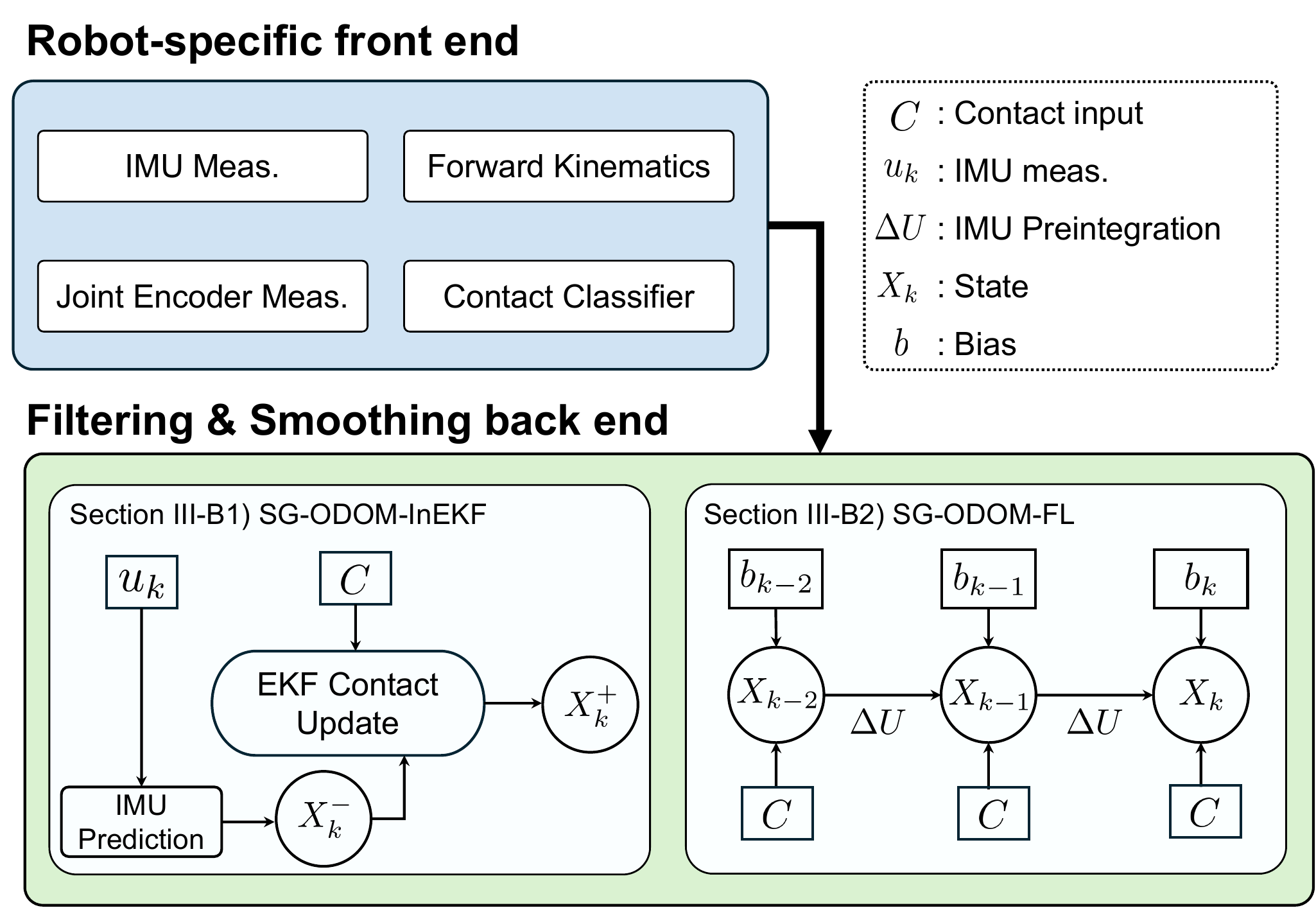
A robot-specific front end converts IMU and joint-encoder measurements into common inputs: IMU measurements, foot positions from forward kinematics, and contact information. The contact classifier estimates the vertical ground reaction force from joint torques and accepts a contact only after the load is sufficient and the force variation stays limited for a validation interval, rejecting the transient that follows impact. A shared InEKF or fixed-lag smoother back end propagates the IMU at full rate and applies kinematic corrections only at validated touchdowns, or when the time since the last correction reaches a maximum dead-reckoning interval.
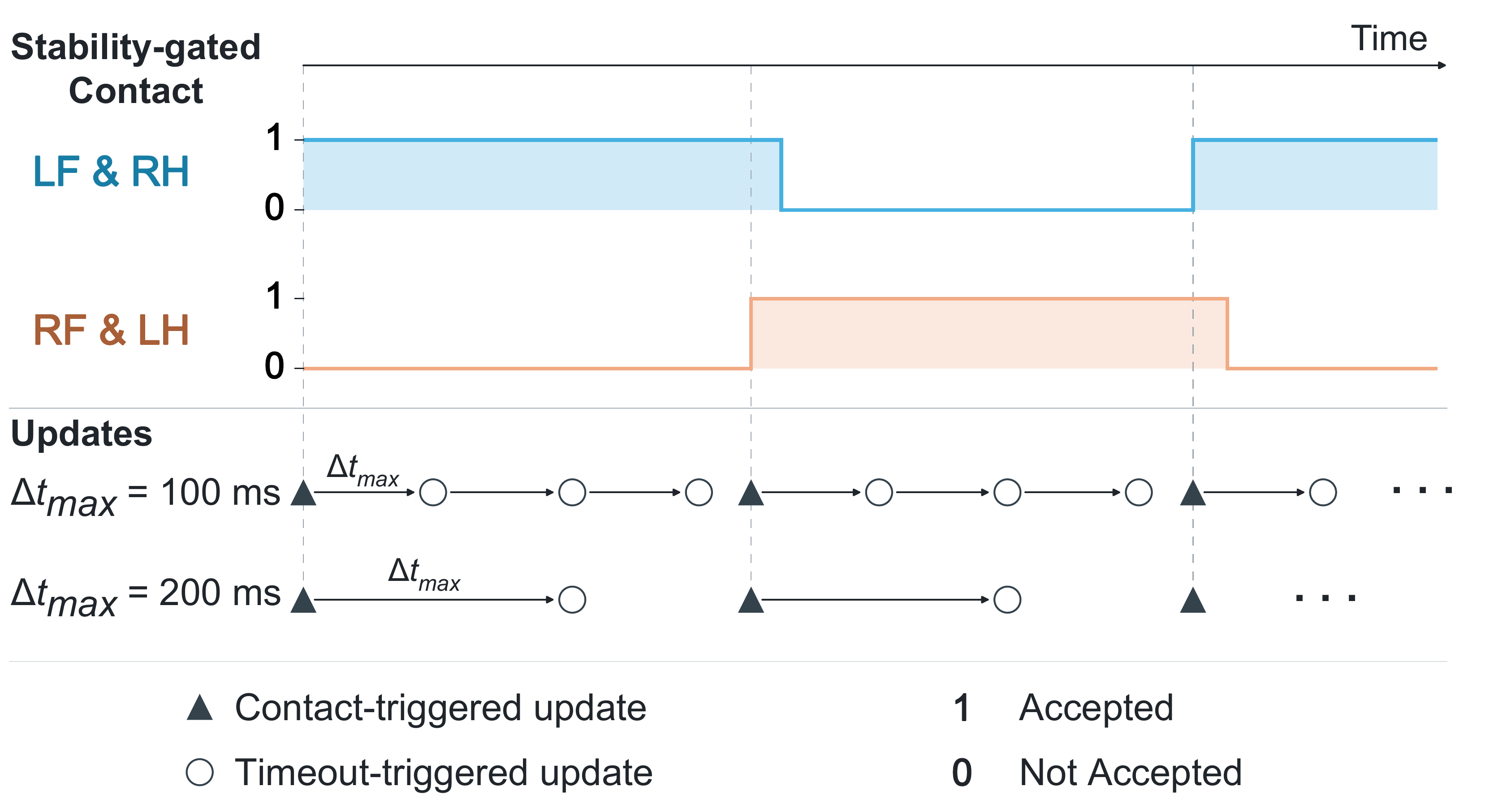
Because every touchdown resets the dead-reckoning interval, corrections follow the sequence of contact events rather than a fixed sampling grid. All contact measurements are still processed, but closely spaced, strongly correlated measurements from the same contact phase no longer trigger repeated corrections.
Citation
@article{iotti2026sgodom,
  title={{SG-ODOM}: Event-Driven Proprioceptive State Estimation with Stability-Gated Contact Updates for Legged Robots},
  author={Iotti, Francesco and Noh, Chiyun and Angelini, Franco and Garabini, Manolo and Kim, Ayoung and Fallon, Maurice and Dellaert, Frank},
  journal={arXiv preprint arXiv:2611.20710},
  year={2026}
}